The Real State of Tokenization: Experts React to the RWA Market’s Liquidity Problem
A new BeInCrypto Intelligence report, built with market data from RWA.xyz and feedback from BeInCrypto’s Expert Council, tracks roughly $60 billion in tokenized real-world assets across more than 7,000 products and 12 asset classes.
The findings show a market that is growing, but still narrow.
- Just 62 assets hold 88% of total value. Five products account for roughly half the market: Figure HELOC, Circle USYC, Tether Gold, BlackRock BUIDL, and Justoken JMWH.
- The activity gap is just as stark. Across 1,289 tokenized assets valued above $100,000, 910 assets worth $32.9 billion showed zero weekly transfers.
- Access is also limited. The report found that 97% of the market sits outside US retail reach. Only about $1.7 billion is legally accessible to US retail investors.
Meanwhile, tokenized stocks are growing fast by product count, but the report found that 59% of stock tokens provide synthetic price exposure rather than actual ownership of the underlying shares.
These findings raise a direct question: is tokenization failing to deliver on liquidity, or is the market still in an early infrastructure phase?
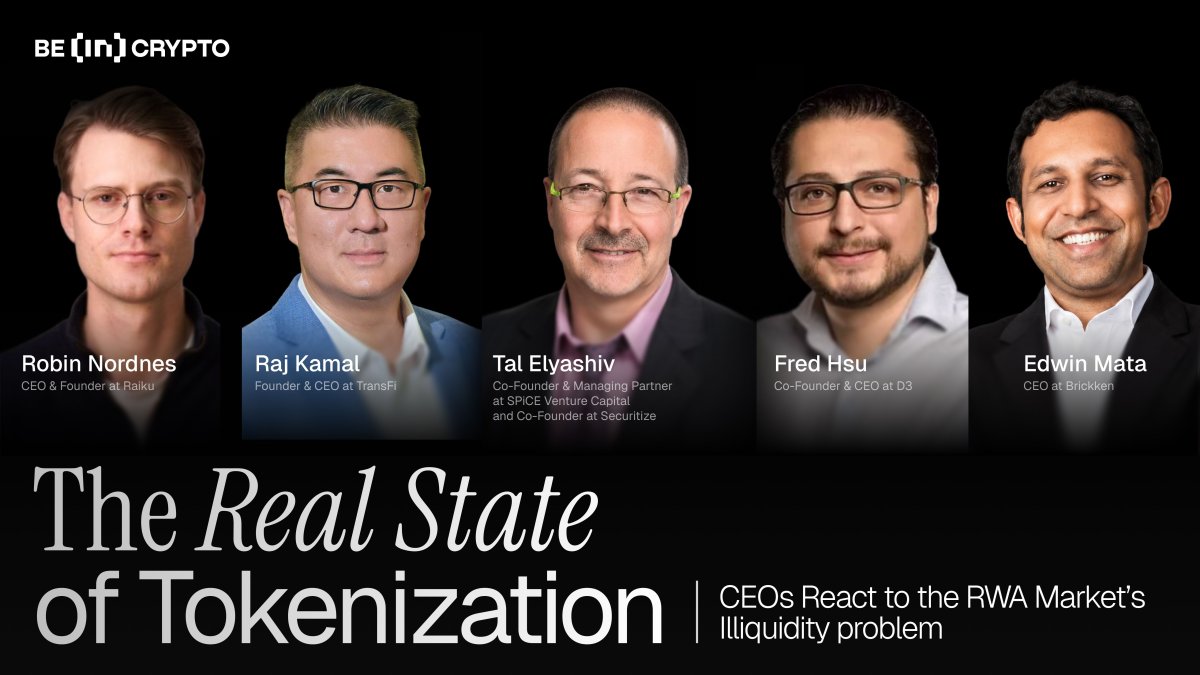
BeInCrypto asked five industry executives to respond to the report’s findings.
Securitize: The First Phase Was Never About Public Trading
Tal Elyashiv, Co-Founder and Managing Partner of SPiCE Venture Capital and Co-Founder of Securitize, said the report’s finding on tokenized equities points to a real structural issue.
“My stance on what the report shows about tokenizing shares/equity, is that this tokenization needs to be at the source. Tokenization that does not include full ownership is problematic at best, and completely wrong IMHO. This is exactly what Securitize is doing.”
Elyashiv also argued that low transfer activity should not be read as failure in every case. Many early tokenized products were designed for institutional issuance, compliance, and settlement, rather than public secondary trading.
“Many of the first assets tokenized were funds (VC funds, private funds). Tokenization in these cases was not done to facilitate retail/public trading, but rather to upgrade institutional issuance infrastructure, compliance, and settlement. BUIDL for example, was created for institutional TradFi and DeFi use cases (and this is what it serves)”
That view matches one of the report’s central distinctions. Some assets are Distributed and can move across public blockchain rails. Others are Represented, using blockchain mainly as a digital record of an off-chain position.
For Elyashiv, that first stage had to prove resilience before tokenized assets could move into broader distribution.
“The previous stage needed to succeed and show resilience, as well as regulatory clarity, before moving to the public trading stage. But we are entering that phase.”
Raiku: Activity Depends on Predictable Execution
Robin Nordnes, CEO and Founder of Raiku, said the dormancy data points to a deeper infrastructure problem.
The report found that more than half of tokenized market value showed no weekly transfer activity. Nordnes said this is not mainly about asset quality or regulation. He said institutions need predictable execution before they actively manage capital on-chain.
“The dormancy finding doesn’t surprise me, and I don’t think it’s primarily a regulatory story or an asset quality story,” Nordnes asserts. “What we hear consistently from institutional allocators is that they won’t actively manage capital on-chain until they can answer two questions with confidence: will my transaction execute, and when… For passive holding that’s tolerable. For active trading, collateral management or intraday rebalancing, it isn’t.”
That issue becomes more important if tokenized assets are used for active trading, collateral management, or daily fund operations. In those settings, uncertainty around settlement timing can affect spreads, liquidity buffers, and portfolio decisions.
“The transaction fee is actually the smaller part of the problem,” Nordnes explains. “The bigger cost of execution uncertainty is everything that sits around it: the wider spreads you need to run if you can’t guarantee timing, the liquidity buffers you hold because you might not execute when you need to, the positions you simply don’t take because the uncertainty makes the trade unmodelable.”
D3: The Weak Spots Show Where Growth May Come From
The report found that only one of 12 asset classes has reached production-grade maturity: US Treasury debt.
Fred Hsu, Co-Founder and CEO of D3, said that finding should not be read only as a weakness. Instead, he said it shows where tokenization may have the most room to create value.
“Only treasuries have reached production grade so far, and almost every other class is still concentrated or experimental. That looks like a weakness, but it is really a map of where the value is. The classes that never matured are the fragmented, illiquid markets traditional finance never priced well, because tracking ownership and moving value cost too much. The asset was always real, what was missing was a way to reach it. The infrastructure that finally reaches those markets is what decides where the next phase of growth comes from,” Hsu told BeInCrypto.
Treasuries are easier to tokenize because the asset class is liquid, familiar, and easier for institutions to assess. More complex assets, including private credit, commodities, real estate, and tokenized equities, still face legal, operational, and distribution barriers.
TransFi: Stablecoins Show Where Tokenization Already Works
Raj Kamal, Founder and CEO of TransFi, said the report’s findings should be considered alongside stablecoins, which the report excludes from its core $60 billion RWA market figure.
Kamal argued that stablecoins remain the clearest example of tokenization solving real-world problems at scale.
“In my view, the real RWA tokenization that is solving real world problems is stablecoins. Where there is a tokenization happening of a real world asset – the US dollar. Through USDC and USDT, billions of dollars of stablecoins are making remittances, B2B flows, payroll & freelancer payments, ecommerce checkouts, corporate treasury flows and forex flows and many other payments faster, easier, more predictable and cheaper.”
That argument does not erase the liquidity gap in tokenized securities and funds. But it shows that tokenization can work when the product solves a clear workflow problem.
Kamal said the next wave of adoption may come from payments and corporate use cases, where stablecoins already have strong demand.
“And the proof points come from an ever-increasing number of large traditional institutions looking to get into stablecoin issuance, Western Union, PayPal, Banks and others. And the reality is that we are just scratching the surface of the multi-trillion dollar traditional payments that is likely to move on to stablecoins. We should be celebrating this clear game changer in global payments as proof of RWAs working,” Kamal notes.
Brickken: The Market Is Still Building the Access Layer
Edwin Mata, CEO of Brickken, said the report’s numbers reflect a market still early in institutional adoption.
He said the first phase of tokenization focused on trust, regulatory readiness, and compliant infrastructure. The next phase will depend on whether tokenized assets become easier to access and use.
“These numbers make sense and reflect the current state of the market, tokenization is still early in institutional adoption and that’s how it was supposed to be. The first phase was always about trust: proving the tech works, meeting regulatory bars, getting compliant infrastructure in place. In essence, that groundwork isn’t wasted time but rather the foundation on which everything else will be built.”
Mata compared the path ahead to stablecoins. In his view, tokenized assets will grow when they solve practical business problems, not simply because they exist on-chain.
He said the winners will be the platforms that make tokenized assets discoverable, interoperable, and usable in real workflows.
“Tokenized markets are heading the same direction, as regulation clarifies (Clarity Act or MiCA in Europe is a good example) and infrastructure matures, the winners will ultimately be whoever builds the access layer: discovery, interoperability layers, the infrastructure that turns a tokenized asset from a static record into something businesses and institutions can actually rely and build on.”
The Takeaway: Tokenization Has Value, But Not Yet Depth
The report does not show that tokenization is dead. It shows that the market is still early in its structure.
The assets exist. Major institutions are involved. Treasuries have reached production-grade maturity. But much of the market remains concentrated, restricted, or inactive on-chain.
That makes the next phase clear. Tokenization will not scale only by minting more assets. It needs better settlement, compliance, distribution, execution, and access.
The first phase proved that real value can be represented on-chain. The next phase will determine whether those assets can become active financial markets.
Read the full BeInCrypto Intelligence report here.
Source: BeInCrypto
Cryptocurrency News

Random quote about money
"Благосостояние государства обеспечивают не те деньги, которые оно ежегодно отпускает чиновникам, а те, что оно ежегодно оставляет в карманах граждан."
Interesting posts in other sections of the blog







 ↑
↑
* to search the proxy database, just enter a country name, e.g. Russia, USA, Thailand