On-Chain, But Not Risk-Free: Inside Atlas System’s Smart Cycle Architecture
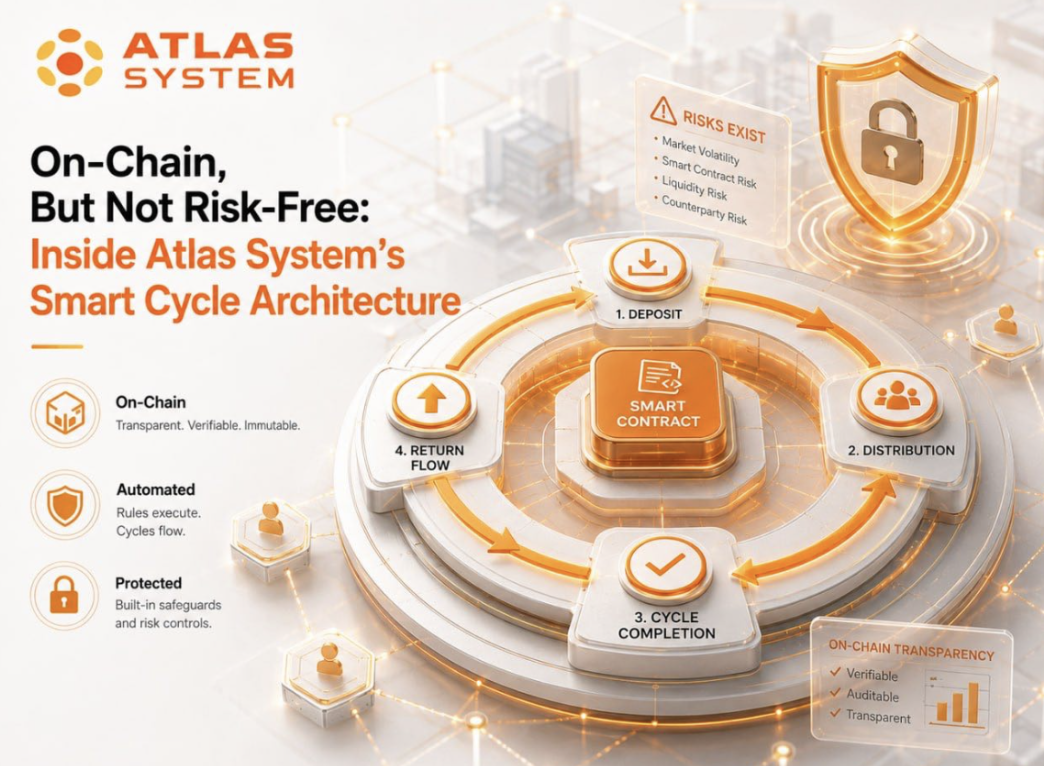
For years, many online earning platforms have operated behind closed interfaces. Users could see balances, timers, referral structures and payout requests inside a dashboard, but they often had little ability to verify how funds moved, how rules were enforced or whether the system’s internal accounting matched reality.
Atlas System is entering that category with a different proposition: move the core logic on-chain. The project describes itself as a Web3 platform for voluntary mutual financing, built around Hybrid DAO mechanics, smart contracts and public blockchain verification. Its first product, Smart Cycle v1, is designed to place participation, claim logic and liquidity movement into a structure that users can inspect through BNB Chain and BscScan. The idea is not that blockchain removes risk. It does not. Instead, Atlas System’s pitch is that users should be able to verify more of what is happening under the hood.
From platform promises to contract-level visibility
Atlas System’s first release is built around Smart Cycle v1, a set of contracts deployed on BNB Smart Chain. The system uses USDT BEP-20 as its settlement asset and separates the architecture into several contract roles. The two main user-facing contracts are Lockup Flow and Daily Flow.
Lockup Flow is designed for fixed-term participation. A user selects a cycle, sends USDT into the contract and receives an on-chain order that records the amount, tier, maturity period and claim conditions. Once the selected term has ended, the user can submit a claim according to the contract’s logic and available liquidity.
Daily Flow follows a different structure. It is designed around a daily payout cycle, where calculated amounts become available progressively during the participation period rather than only at the end of a fixed lockup.
Atlas System also uses separate contracts for routing and partner-related accruals. Transport is used for routing and liquidity transfer, while Distribute is responsible for distributing and paying out partner accruals. This structure separates user participation flows from partner distribution mechanics, making each layer easier to inspect independently.
For users, this means activity is not limited to a private interface. Wallet interactions, token transfers, contract calls and claim-related transactions can be reviewed directly on BscScan.
Why BNB Chain matters
BNB Chain gives Atlas System a practical execution layer: low-cost transactions, BEP-20 support, high user familiarity and a widely used public explorer through BscScan.
That matters because the platform’s core claim is based on verifiability. A user can check whether their wallet interacted with the correct contract, whether USDT was transferred, whether a claim transaction was submitted and whether payout-related activity appears on-chain.
This does not make the platform risk-free. It does, however, change the information environment. In a closed online platform, users rely almost entirely on what the dashboard says. In an on-chain architecture, the dashboard can be compared against blockchain data. For a sector where trust has often depended on marketing, community momentum or the reputation of platform operators, that shift is meaningful.
PancakeSwap V3 and liquidity mechanics
A core part of the Smart Cycle v1 architecture is its interaction with PancakeSwap V3 liquidity infrastructure. Atlas System’s technical materials describe a shared base layer, PositionHandler, which handles interaction with PancakeSwap V3 liquidity positions.
In practice, PositionHandler connects Smart Cycle logic to an underlying liquidity position. It supports adding liquidity, removing liquidity and validating the active position used by the system.
This design makes liquidity a central part of the user experience. Claims and calculated payouts are not abstract numbers created outside the system. They depend on contract logic, liquidity routing and the conditions available inside the system at the time of the user’s request. That is also where the risk becomes clear.
Transparency does not equal safety
Atlas System’s own materials state that participation is voluntary and that return of contributed funds or additional calculated amounts is not guaranteed. Execution depends on available liquidity in the smart contract, which is formed by participants in the system. This distinction is important. Putting a model on-chain can make it more transparent, but it does not remove liquidity risk, smart contract risk, governance risk or operational risk. For an editorial audience, this is not a footnote. It is central to understanding the project.
A test case for online earning models
The broader question is whether on-chain infrastructure can change expectations for online earning platforms. Historically, users in this category have often accepted limited visibility. They joined platforms through referral networks, tracked balances through internal dashboards and trusted that payout logic was being applied as described.
Atlas System is trying to move that model toward a more verifiable standard. Its architecture gives users contract addresses, token flows, BscScan activity, published source code, whitepaper documentation and third-party audit reports.
That does not automatically make the model sustainable. Sustainability still depends on liquidity, participant behavior, contract design, operational decisions and whether the project addresses disclosed risk areas over time. But it does create a different baseline. Instead of asking users to trust a black box, Atlas System is asking them to inspect a system that exists, at least in part, on-chain.
About the Project
Platform | X | Facebook | TikTok | Telegram Channel | Youtube | GitHub
Source: BeInCrypto
Cryptocurrency News


Random quote about money
"Время и деньги - самое тяжкое бремя в жизни, поэтому самые несчастные из смертных - это те, у кого и того, и другого в избытке."
Interesting posts in other sections of the blog








 ↑
↑
* to search the proxy database, just enter a country name, e.g. Russia, USA, Thailand