

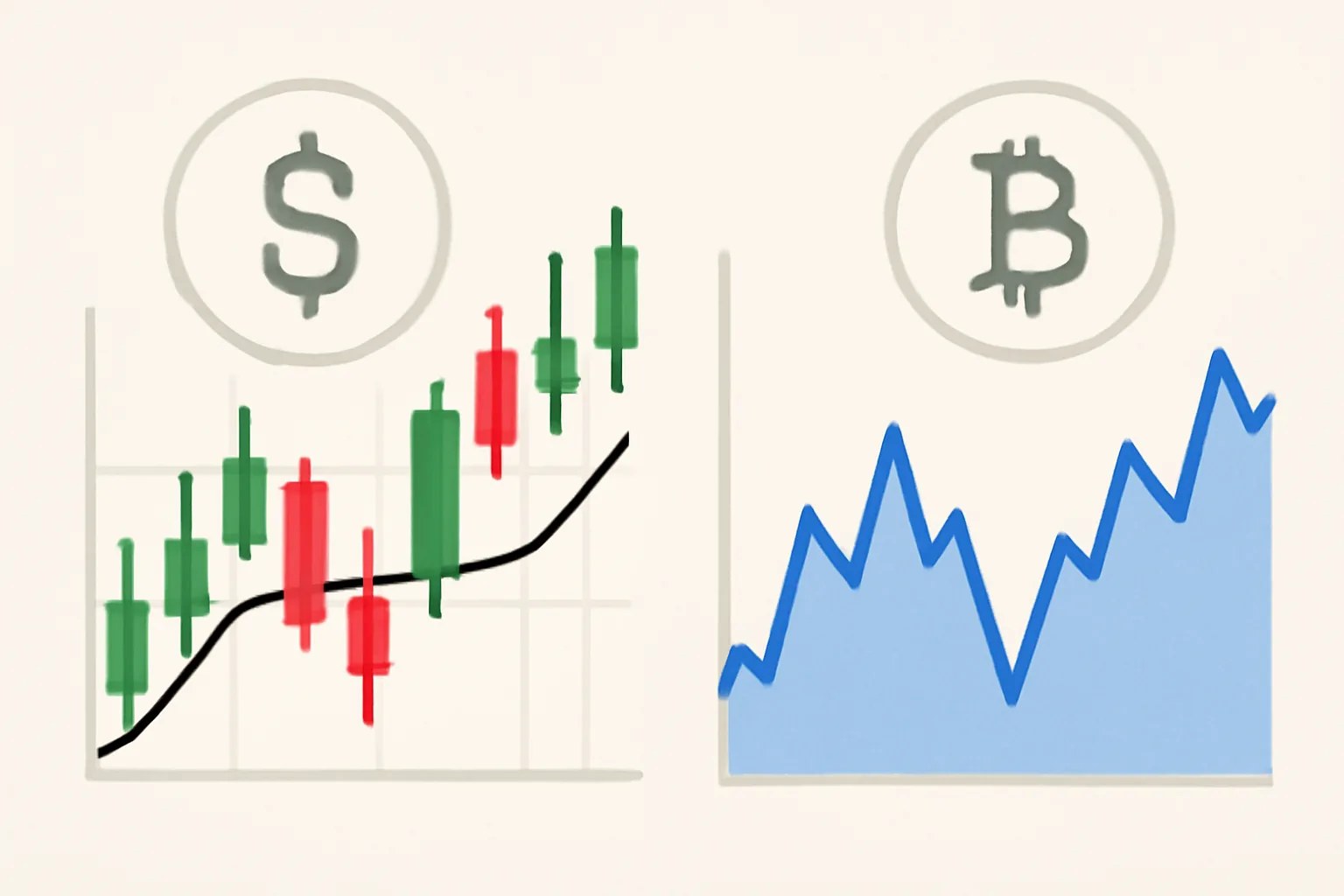
What Forex Trading Is
Forex trading is the buying and selling of one currency against another. A trader might buy EUR/USD at 1.08 and later sell it at 1.09, hoping the euro rises against the dollar. That pair format is the heart of forex. Nothing fancy, just two currencies and a quoted price.
The market exists because businesses, banks, tourists, and governments need money in different currencies every day. A company paying suppliers in Japan may need yen, while an exporter receiving dollars may later convert them into euros. Those flows create constant demand. Forex is huge, but the trade itself is simple.
Most traders do not hold cash notes. They trade contracts through a broker, often with small account sizes and tight spreads on major pairs. EUR/USD, GBP/USD, and USD/JPY are common examples. A spread of 1 pip can matter fast when a position is large.
Forex also runs in pairs, which means one currency is always measured against another. If you buy USD/CHF, you are not betting on the U.S. dollar alone. You are betting on the relationship between two currencies. That distinction matters.
What Crypto Trading Is
Crypto trading is the buying and selling of digital assets such as Bitcoin, Ether, and other tokens on an exchange or broker platform. A trader can buy spot crypto and hold it, or trade derivatives if the platform offers them. The market never sleeps. It runs 24/7, including weekends.
There are different ways to trade crypto. Spot trading means owning the asset directly. Futures and perpetual contracts let traders speculate on price without holding the coin itself, though those products add their own risks. Some traders also use margin, which can magnify losses as quickly as gains.
Crypto markets are not tied to a single central bank. Prices can move on exchange listings, network upgrades, ETF headlines, social media posts, or a large wallet transfer. A rumor can move the market in minutes. That is part of the appeal, and part of the damage.
For readers comparing platforms, the practical side matters too. Fees, custody, order types, and exchange reliability all affect results. A useful starting point is crypto exchange order types explained, because the order ticket often decides whether a trade behaves as planned or not.
Key Differences Between Forex and Crypto Trading
The differences between forex and crypto trading start with the asset itself. Forex is built around national currencies. Crypto is built around digital tokens with different rules, networks, and supply models. One is tied to sovereign money. The other is not.
Market hours are another clear split. Forex is open 24 hours a day on weekdays, then closes for the weekend. Crypto trades continuously, 7 days a week, which means a sharp move can happen at 3 a.m. on Sunday and still affect your position. There is no bell to save you.
Liquidity also differs by pair and platform. Major forex pairs tend to have deep liquidity, especially during the London and New York sessions. Crypto liquidity can be strong in Bitcoin and Ether, yet thinner in smaller coins and on less active exchanges. Thin books can cause slippage on larger orders.
Price drivers are different too. Forex often reacts to interest rates, inflation, employment data, central bank comments, and trade balances. Crypto can react to those same macro themes, but it also responds to protocol changes, exchange hacks, token unlocks, and sentiment on social media. One market listens closely to central banks. The other often does not.
Regulation is another major divider. Forex brokers usually operate under financial licenses in specific jurisdictions, and many retail clients face strong disclosure rules. Crypto regulation depends on the country, the exchange, and sometimes the token itself. A trader may have better consumer protections in one market and more product freedom in the other. That trade-off is real.
One practical difference shows up in research. Forex traders often watch economic calendars and central bank statements, while crypto traders may watch on-chain activity, exchange inflows, and sentiment tools such as the cryptocurrency fear and greed index. Different market, different clues.
How Volatility and Risk Compare
Crypto is often considered more volatile than forex. A 5% move in a major currency pair would be unusual in normal conditions, while a 5% move in a major crypto asset can happen in a single session or even faster. That does not make crypto “bad.” It makes crypto less forgiving.
Volatility cuts both ways. A trader can see a larger gain in crypto with a smaller price move, but the same leverage can erase an account quickly. If a position is badly placed, the market does not care whether the asset is digital or national currency. It only moves.
Forex still carries meaningful risk. A surprise rate decision, a geopolitical shock, or a thin-market gap can damage a position quickly. Traders sometimes underestimate forex because the biggest pairs look calm on short charts. Calm is not the same as safe.
Risk control matters more than opinion. Stop-loss orders, modest position sizing, and avoiding oversized leverage matter in both markets. If a trader ignores those basics, the market eventually collects the bill. Usually with interest.
Crypto traders should also watch custody risk, exchange risk, and wallet security. Price is only one problem. If an exchange freezes withdrawals or a key is lost, the trade is no longer the only issue. For a deeper look at operational risk, see what changed in crypto exchange security.
Trading Costs and Market Access
Trading costs in forex usually include spreads, commissions, and sometimes overnight financing charges. A low spread on a major pair can look attractive, but a commission account may still cost more overall depending on trade frequency. The details matter more than the ad copy.
Crypto trading costs vary by exchange. There may be maker and taker fees, withdrawal fees, network fees, and funding costs on derivatives. A trader who moves funds often can lose more to fees than to bad entries if the platform pricing is poor. That happens more often than people admit.
Access is also different. Forex trading often runs through a broker with a margin account, identity checks, and platform rules. Crypto trading usually starts at an exchange, though some brokers offer crypto exposure too. The registration process can be shorter on some crypto venues, but that is not the same as being safer.
Leverage appears in both markets, but the limits and rules can differ by jurisdiction and product. Forex brokers may offer relatively high leverage to retail traders in some regions, while crypto exchanges may offer separate spot and futures products with distinct margin requirements. High leverage makes small moves feel large. It does not improve judgment.
For traders who care about transaction logistics, one practical topic is crypto exchange tax reporting for trades. Taxes can change the real cost of crypto trading, especially for active accounts with many fills and withdrawals.
Trading Strategies That Fit Each Market
Day trading can work in both markets, but the setup differs. In forex, many traders focus on high-volume sessions and economic releases. In crypto, day traders may watch momentum around exchange listings, funding rates, or sudden shifts in market sentiment. Same style, different fuel.
Swing trading often suits both markets because it gives a position time to develop. A forex swing trader may hold EUR/USD for 3 days after a central bank statement. A crypto swing trader may hold Bitcoin for a week after a breakout above resistance. The time frame is similar, yet the catalysts are not.
Trend following often appeals to crypto traders because big directional moves can persist longer than expected. A clean weekly trend in Bitcoin can produce multiple entries if risk is controlled. Forex trend following can also work, especially on major pairs, but sudden macro events can interrupt the move. The trend is never a promise.
Range trading can be useful in forex when a pair is stuck between known support and resistance levels. It can also work in crypto, though breakouts may be more violent. A range trader in crypto needs sharper stops. No room for wishful thinking.
Some traders build systems around order behavior, and that is where platform mechanics matter. A guide like how to use a crypto exchange can help traders connect charts, orders, and alerts without guessing at the process.
For people who study broader crypto methods, best cryptocurrency investment strategies may be useful too, especially for readers deciding whether they want active trading or a slower approach.
Which Market May Be Better for Different Types of Traders
Beginners who want a steadier environment may find forex easier to observe at first. Major pairs often move in a more measured way, and the macro calendar gives a structured way to study events. That does not mean forex is easy. It means the rhythm is more familiar to many new traders.
Crypto may suit traders who are comfortable with fast markets, weekend moves, and platform differences. Someone who checks charts only once a day may be surprised by a large overnight swing. Someone who watches the market closely may see more opportunity. Both are true.
Time commitment matters. Forex often rewards traders who can follow sessions and scheduled data releases. Crypto can demand more attention because it does not close, and sharp moves may occur outside normal business hours. A trader with a full-time job may prefer one schedule over the other. That preference matters more than theories.
Risk tolerance should shape the choice too. A conservative trader may prefer the slower pace and larger institutional structure of forex. A trader who accepts bigger swings and more platform risk may prefer crypto. Neither answer is universal. The account size and the emotional response to loss matter more than the label on the market.
Experience level also changes the answer. A trader still learning entries, exits, and position sizing may find crypto fees, wallet decisions, and exchange mechanics distracting. A trader with a background in technical analysis may adapt faster to crypto, especially if they already understand order flow and volatility.
There is also a practical question of record keeping and transfers. If a trader moves funds between platforms often, basic operational habits become part of the edge. A simple reference such as how to move crypto from coinbase can save mistakes before they become expensive.
Conclusion
Forex and crypto both offer price movement, charts, and the chance to lose money quickly. They are not the same market. Forex is tied to currency pairs, bank policy, and weekday sessions. Crypto is tied to digital assets, constant trading hours, and a faster news cycle.
A trader choosing between them should start with one number: how much time can be spent watching the market each week? If the answer is 5 hours, that points one way. If the answer is 30 minutes here and there, that points another way. The market should fit the schedule, not the other way around.
The better first step is not prediction. It is choosing the market whose rules you can explain clearly after one week of study, one demo trade, and one reviewed mistake.